

Acupuncture in Bend, Oregon
Acupuncture offers a gentle prompt to your body’s own intelligence and its remarkable capacity to regulate, repair, and heal.
WAYS TO TAKE CARE
Deeply individualized, whole-person care.
Your body is an ecosystem: intelligent, interconnected, and always adapting on your behalf. Chinese medicine works with those relationships, looking beyond any single symptom to understand the larger terrain shaping how you feel.
That is where we begin. With your body, your history, your rhythms, and what life is asking of you now. Whether you come for fertility, hormonal health, pain, digestion, migraines, sleep, recovery, or chronic stress, care is shaped around the whole of you.
Your body evolves. Your care should evolve with you.
Acupuncture Visit Types
-
Where we begin. A spacious first visit to understand your health history, current concerns, and what you hope care can support. We’ll begin with a full Chinese medicine assessment, review relevant labs or imaging, start treatment, and map a clear path forward together.
New acupuncture patients currently begin care at SHIFT Functional Medicine.
Includes: comprehensive intake + assessment · relevant lab/imaging review · extended acupuncture treatment · personalized recommendations + treatment plan
-
The rhythm of care. Visits include time to check in, reassess, and continue the work with treatment shaped around where you are today.
Includes: focused check-in + reassessment · acupuncture treatment · ongoing refinement of your care plan · bodywork as time allows
-
When care needs more room. A longer session for periods of change, complex concerns, deeper reassessment, or simply when there is more to tend. We’ll have added space for treatment, reviewing new information, and recalibrating the plan together.
Includes: extended treatment · deeper reassessment · relevant lab/imaging review · updated recommendations + care plan
Ancient wisdom for modern life.
Classical Chinese Medicine and modern physiology offer different languages for the same living body.
I read pulse, tongue, constitution, symptoms, cycles, labs, imaging, and lived experience together, letting each sharpen the whole picture and guide care that is both deeply rooted and relevant to modern life.
What Becomes Possible Over Time
The longer we work together, the more care can shift from tending what hurts toward helping you stay well.
Over time, acupuncture becomes steady, seasonal medicine: supporting you through the year, through change, and through the evolving needs of your body with greater resilience, rhythm, and ease.
Acupuncture is for every body
Acupuncture is for every body
Schedule Acupuncture
New Here?
New acupuncture patients currently begin care at SHIFT Functional Medicine.
SHIFT Functional Medicine
Mondays, Tuesdays + Fridays
2220 NW Labiche Ln, Ste 110
Bend, OR 97703
New + established patients
Already in care?
Established patients are welcome at SHIFT or Lumi House. Choose the setting and day that works best for you.
Lumi House · Old Bend
Thursdays
Established patients.
How Acupuncture Works
For thousands of years, Chinese medicine has studied the human body in relationship with nature, tracing within us the same rhythms of circulation, adaptation, rest, growth, and change.
Across generations, practitioners learned that a remarkably small intervention — a fine needle, placed with precision — could create effects far beyond the point itself. Today, advances in physiology, imaging, and clinical research give us a fascinating peek under the hood, allowing us to measure some of those responses in entirely new ways.
And this is the part I never stop finding astonishing: the needle is the signal. Your own biology creates the response.
A needle can start a neural conversation
In mechanistic animal research, electroacupuncture activated a traceable sensory-neuron → brainstem → vagal-adrenal pathway involved in inflammatory regulation.
Pain relief that lasts
20,827 people. 39 randomized trials. Better outcomes than sham and no-acupuncture controls across several chronic pain conditions, with roughly 85% of the treatment benefit remaining a year later.
Fascia physically responds to the needle
Needle rotation mechanically couples with connective tissue; anatomical research has found intriguing relationships between acupuncture-point locations and connective-tissue planes.
We can watch blood flow change
Human physiology studies have measured changes in skin and muscle microcirculation following acupuncture.
Your body makes its own pain medicine
Human physiology studies have measured changes in local muscle and skin blood flow following acupuncture stimulation. Experimental research has also identified adenosine — one of the body’s own pain-modulating molecules — as one pathway involved in acupuncture analgesia.
The sexiest part? Nothing is being added. The needle is information. Your body supplies the chemistry, the circuitry, the circulation, and the response.
And this is the part I never stop finding astonishing: the needle is the signal. Your own biology creates the response.

There is extraordinary power in care designed around you.
Acupuncture can change what hurts. Individualized care can also change how you sleep, move, recover, respond to stress, understand your body, and participate in your own life.
Relief matters because of what it makes possible: moving freely, recovering fully, caring for the people you love, meeting change with greater resilience, and having more of yourself available for the life you are here to live.
May you be + live well.
Common Questions
Still curious? Start here, or visit the full FAQ for more.
-
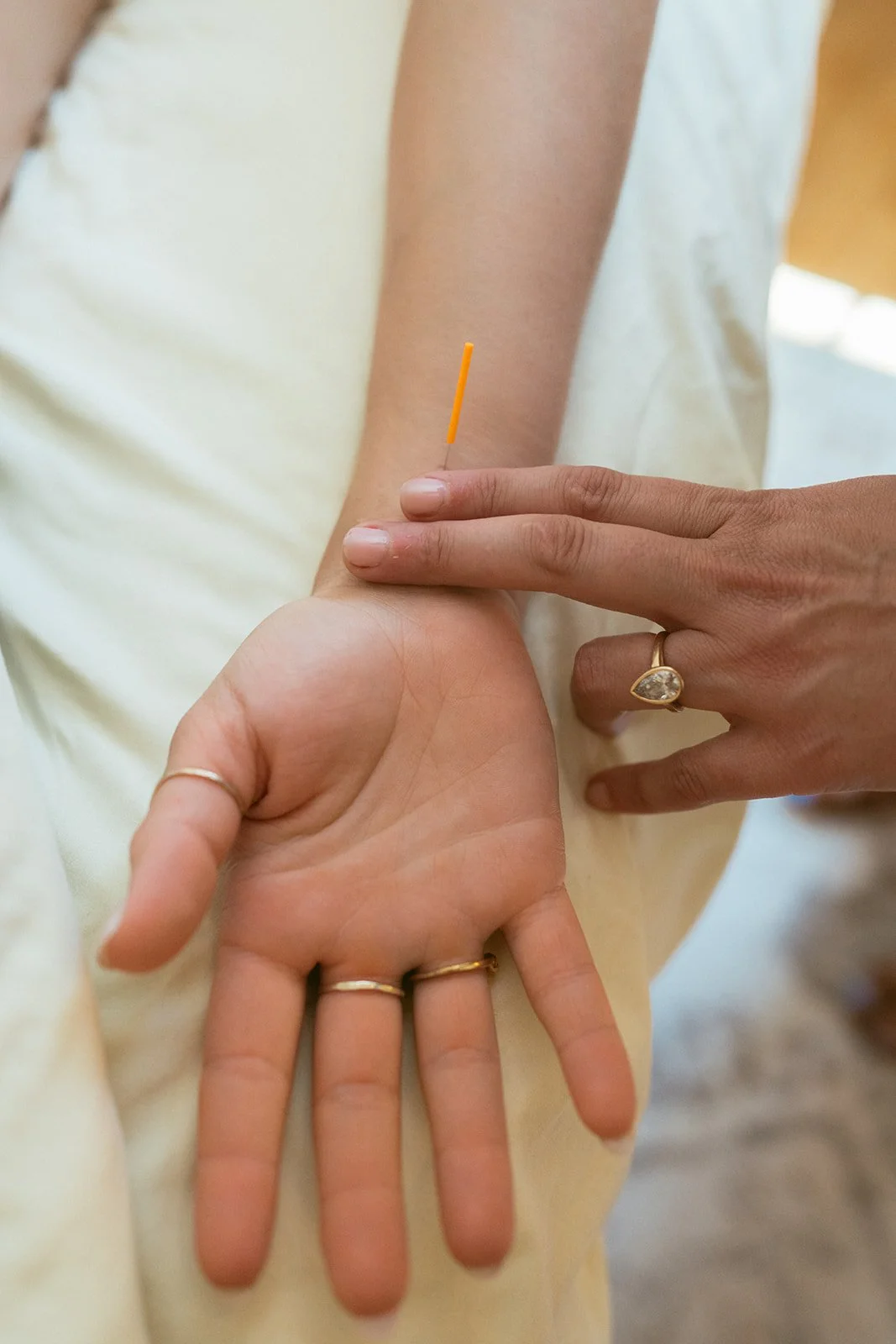
Acupuncture needles are hair-thin, and they're inserted gently and shallowly — nothing like the needles you're picturing from the doctor's office. Everyone experiences it a little differently, but most people feel only the smallest sensation on insertion, or a brief, dull heaviness we call the arrival of qi. Once the needles are in, most settle into a deep, easy calm — I lovingly call it being acu-stoned — a feeling of relaxation and wellbeing that often lasts for hours after you leave. Plenty of people fall asleep on the table.
-
Every treatment is tailored to you, and I draw from the full toolkit of East Asian medicine as your body needs it. Alongside acupuncture, a session may include cupping, gua sha, moxibustion (moxa), East Asian bodywork, or electroacupuncture — chosen to move stagnation, ease pain, warm and nourish, and support your nervous system. You'll always know what to expect before we begin.
-
It's a subtle distinction, and a meaningful one to me. Traditional Chinese Medicine (TCM) is the standardized system codified in China in the mid-twentieth century — streamlined, systematized, and often practiced in a more protocol-based way alongside conventional medicine. I know it deeply and draw on it often, especially where it meets modern research. Classical Chinese Medicine reaches further back, to the older texts and lineages TCM was distilled from — and to a richer map of the body's channels.
Beyond the familiar meridians, the classical tradition works with deeper pathways — the luo vessels, the divergent channels, and the eight extraordinary vessels — that hold our constitution, our deepest patterns, and the places we store what we haven't yet had the resources to process. Working with these channels is part of what lets us reach the true root of a pattern, and part of why this medicine can feel so quietly transformative — not only easing symptoms, but shifting something at the level of the whole person.
As a classical acupuncturist, I practice from those older roots: tending the root and the pattern rather than the symptom alone, and shaping each treatment around you rather than a protocol. Both traditions share the same origins, and both can be profoundly effective — the classical lens is simply the one that feels truest to how I understand the body: as an ecosystem, always in relationship with the rhythms of nature.
-
Your first visit runs about two hours — longer than the rest — because it begins with a real conversation. I take a thorough history, read your pulse and tongue, and listen for the pattern beneath what brought you in before I ever place a needle. You'll receive a full treatment shaped around you, and often leave with herbs and a few simple practices to carry home.
-
It depends on what you're working with and how long it's been present — but here's the honest shape of it. In the first several weeks, consistency matters most. We're coaxing a system into a new rhythm, and each treatment builds on the last, so I usually recommend weekly visits to begin. It's a real commitment, but a hopeful one — it's often remarkable what can shift in the first four to eight weeks, depending on you and what we're tending. From there, most patients find that easing into monthly maintenance is where the deeper magic settles in: steady, preventative care that keeps you well through the seasons of the year, and the seasons of your life. We'll map the arc together at your first visit and adjust as your body responds.
-
The short answer? Just about everything. Chinese medicine is a complete system of medicine, used across Asia for thousands of years to support a remarkably broad range of conditions — and it often shines most with the chronic, complex, or "nothing-quite-explains-it" patterns. If your case is complex, or you're simply wondering whether acupuncture and herbs are right for you, reach out before booking — I'm always glad to talk it through.
-
Before your first visit, you'll complete a few basic forms and your intake through the patient portal, and we'll do your full Chinese medicine intake together. If you have recent labs or imaging relevant to your care, upload them to the portal at least 48 hours ahead — reviewing them is included in your initial assessment.
Otherwise, keep it simple: hydrate well in the days leading up to and the day of your treatment, eat something beforehand (arriving hungry can leave you lightheaded), and wear comfortable clothing that rolls up past the elbows and knees. If I ever ask you to uncover an area, you'll always have privacy and a comfortable way to cover up.
Afterward, give yourself a little spaciousness if you can — unhurried time to integrate, rather than a hard workout or a stressful meeting right after. Many people leave wonderfully mellow, and your body settles best when you let that calm linger.
-
Check out our other Frequently Asked Questions.